-
tel:
+86 181 6205 2962 -
email:
operators@sdchinamachine.com

1 Ton vs 2 Ton Mini Excavator for Different Job Sites
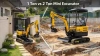
The Same Excavator Size Does Not Fit Every Job
A mini excavator that works well on one site may be inconvenient on another. The difference is often not the type of excavation, but the conditions around it.
Consider a residential landscaping project with a narrow gate. Then compare it with a drainage project where the excavator has plenty of access but needs more digging range. Both jobs may be described as “small excavation,” but the machine requirements are different.
Residential Landscaping: Access Often Comes First
Landscaping work frequently takes place around existing houses, gardens, fences and paved areas.
In these situations, machine width and overall compactness can become important before digging performance is considered.
A 1 ton mini excavator can be worth examining when the main challenge is getting the machine onto the property without removing fencing or changing the site entrance.
Hightop's HT10B, for example, uses a retractable track configuration with a published range of 830–1000 mm. Its listed operating weight is 1,000 kg.
The exact access requirement should still be measured on the jobsite. A published machine width should never be treated as a substitute for checking the actual entrance.
Trenching and Drainage: Look at Working Range
For trenching, the important question changes.
Instead of focusing only on whether the machine is compact, consider the required digging depth, digging radius and the amount of room available beside the trench.
A 1 ton excavator may suit smaller trenching work when its published working range meets the project requirement. If the job regularly demands greater working range, a 2-ton-class machine may become relevant.
The comparison should therefore be made against the actual trench dimensions rather than the machine's tonnage alone.
Small Construction Sites: Consider the Whole Work Cycle
On a compact construction site, the excavator may perform several different tasks during the same project.
Digging is only one part of the work. The machine may need to reposition repeatedly, work around structures, load or move material with an attachment, and travel between different parts of the site.
In this situation, compare:
- Overall machine dimensions
- Working range
- Tail or swing requirements
- Operating weight
- Attachment compatibility
- Transport arrangements
A 2-ton machine can provide a different working envelope from a smaller excavator, but the exact specifications depend on the model. Hightop's 2-ton range includes multiple configurations, so the individual model specification should be checked before making a comparison.
Farm and Property Maintenance: Frequency Matters
For farms and larger private properties, the machine may be used for several different jobs over the year.
One month it may be used for drainage. Later it may be used for landscaping, ditch maintenance or other excavation work.
For this type of ownership, think about the jobs that occur most often. A machine that is easy to transport and access with may be more useful than a larger machine that is only occasionally needed.
On the other hand, if the machine will regularly handle excavation work that exceeds the practical working range of a smaller model, the comparison should move toward the 2-ton class.
Five Questions That Usually Clarify the Choice
How wide is the entrance?
Measure the narrowest point, not the widest part of the property.
How deep is the excavation?
Use the required digging depth from the project rather than estimating from the machine's weight class.
How much room does the machine have to swing?
Existing buildings, fences and other structures can restrict machine positioning even when the excavator fits through the entrance.
How often will it be transported?
Frequent movement between sites makes operating weight and transport dimensions more important.
What type of work will make up most of the machine's operating hours?
Choose the comparison criteria around the work that the machine will actually perform.
1 Ton vs 2 Ton: Compare the Job Conditions
There is no useful rule that says every landscaping job requires 1 ton or every construction job requires 2 tons.
A narrow-access landscaping project can make machine width the deciding factor. A trenching project can make digging depth more important. A mixed construction workload may require a broader comparison of working range, transport and configuration.
That is why the practical way to compare excavators is to put the job requirements next to the specifications of the actual models being considered.
Before You Ask for a Price
Prepare five pieces of information:
- Access width
- Required digging depth
- Main application
- Transport method
- Expected working frequency
With those details, a manufacturer can recommend which specifications should be compared and provide a quotation for a specific configuration rather than a generic machine size.
Hightop's range includes 1-ton models such as the HT10B and multiple 2-ton-class configurations. Reviewing the exact product specifications is the next step after defining the job requirements.
Related News



.webp?x-oss-process=image/resize,w_100/quality,q_100)


.webp?x-oss-process=image/resize,w_100/quality,q_100)


.webp?x-oss-process=image/resize,w_100/quality,q_100)


Contact US
Product Information
Quantity
Unit
Piece
Support order samples, customization, wholesale direct, and complete payment. If the product you look for does not have corresponding customized content, pls fill out the form below to contact us, and we will reply ASAP.