-
tel:
+86 181 6205 2962 -
email:
operators@sdchinamachine.com

Mini Excavator Lifting – 5 Safety Tips for Hoisting Operations
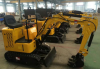
Most operators know how to dig, trench, and grade with a mini excavator. But lifting – hoisting pipes, equipment, or materials – is a different skill. The machine is working in a lever state, and the margin for error is smaller. Here are the five rules that separate safe lifting from a rollover.
1. Use the Bucket Hook – Not the Teeth
Every mini excavator bucket has a hook on the back. That hook is there for a reason. When you're lifting a load that needs to go up – pipes onto a trailer, equipment into a building – use the hook.
The bucket teeth are for digging, not lifting. A rope or sling placed on the teeth can slip off during the lift, especially when the bucket tilts or the load shifts. The hook keeps the sling secure, even at full extension.
When to use the teeth instead: If the load is on the ground right next to the machine and you're just sliding it a short distance, the teeth can work. But for any lift that goes higher than knee level, switch to the hook. Check the hook condition before every lift – a cracked or worn hook is a failure waiting to happen.
2. Level the Machine – Tipping Starts with a Tilt
An excavator lifting on uneven ground is an excavator that's already halfway to tipping. The machine needs a solid, level surface to stay stable under load.
Before you start, check the ground. If you're on a slope, take a minute to dig out a level spot for the tracks. It's a few extra minutes of work, and it's the cheapest insurance against a rollover.
Also pay attention to track orientation. The safest lift happens when the load is directly in line with the tracks – not perpendicular to them. The further the load is from the track centerline, the higher the risk of tipping. If you need to lift to the side, keep the load as low and as close to the machine as possible.
3. Know the Lever – The Boom Comes First
The order of operations matters. When you're ready to lift, raise the boom first. Get the boom into position before you move the arm or bucket.
Once the boom is set, use the arm and bucket to fine-tune the load position. The arm provides reach; the bucket provides tilt and final positioning. But the boom does the heavy lifting. If you try to lift with the arm before the boom is in place, you're putting stress on the wrong part of the machine.
Think of it this way: the boom is your shoulder, the arm is your elbow, and the bucket is your wrist. You wouldn't try to lift a heavy box with just your wrist – you use your shoulder first. Same principle applies here.
4. Keep the Load Low – Height Adds Risk
Every centimeter you raise a load adds risk. The higher the load, the more leverage it has against the machine's center of gravity. A load that's stable at waist height becomes unstable at shoulder height.
Only lift as high as necessary. If you're loading a trailer, raise the load just enough to clear the trailer sides. If you're placing materials, keep them as low as possible during the swing. The extra few seconds it takes to keep the load low are worth the safety margin.
5. Know Your Limits – Distance Reduces Capacity
Every mini excavator has a rated lifting capacity – but that rating assumes the load is close to the machine. The further the load extends from the center of gravity, the less the machine can safely lift.
Here's a rough guide for a 1.5-2 ton mini excavator:
- Close to the machine (within 1m): Close to rated capacity
- Mid-reach (2-3m out): Reduced by 30-40%
- Full reach (arm extended): Reduced by 50% or more
If you're unsure, test the lift before committing. Raise the load just a few centimeters off the ground and check the machine's stability. If the tracks start to lift or the machine feels unstable, reposition closer to the load or reduce the weight.
What to Do If Something Goes Wrong
If the machine starts to tip or the load becomes unstable during a lift, don't freeze. Lower the boom immediately – not slowly, not carefully, but immediately. Let the load drop if you have to. A dropped load can be replaced. A rolled machine cannot.
The priority in any lift is: operator safety first, machine safety second, load safety third. Never try to save a load at the expense of your own safety or the machine's stability.
Frequently Asked Questions
Can I lift with a mini excavator without a bucket hook?
Technically yes, but it's not recommended. Without a hook, you're limited to using the bucket teeth or clamping the load between the bucket and arm – both methods are less secure and increase the risk of the load slipping. If your machine doesn't have a hook, consider installing one.
How much weight can a mini excavator lift?
That depends on the model and the lift radius. A 1.5-2 ton mini excavator can typically lift 1,500-2,000 kg close to the machine, but that drops to 500-800 kg at full reach. Always check your machine's lift chart before hoisting.
What's the safest position for lifting with a mini excavator?
Directly in front of the machine, with the load aligned with the track centerline, on level ground, with the load as close to the machine as possible. Avoid lifting to the side or on slopes.
Do I need a spotter for lifting operations?
Yes. A spotter with clear hand signals or a radio keeps the operator aware of the load position, overhead hazards, and ground conditions. Never lift without a spotter – especially on busy job sites.
What should I check before every lift?
Check the bucket hook for cracks or wear. Check the sling or rope for fraying or damage. Check the ground for levelness. Check the load weight against the machine's lift capacity. And check the lift path for overhead lines or obstacles.
Related News



.webp?x-oss-process=image/resize,w_100/quality,q_100)


.webp?x-oss-process=image/resize,w_100/quality,q_100)


.webp?x-oss-process=image/resize,w_100/quality,q_100)


Contact US
Product Information
Quantity
Unit
Piece
Support order samples, customization, wholesale direct, and complete payment. If the product you look for does not have corresponding customized content, pls fill out the form below to contact us, and we will reply ASAP.