-
tel:
+86 181 6205 2962 -
email:
operators@sdchinamachine.com

1.5 Ton Excavator Lifting Capacity – How Much Can It Really Lift?
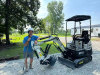
1.5 Ton Excavator Lifting Capacity – How Much Can It Really Lift?
If you're renting or buying a 1.5-ton mini excavator, one of the first questions you'll ask is: how much can it lift? The short answer is around 1,500–2,000 kg under ideal conditions. But the real answer depends on where you're lifting, what you're lifting, and how the machine is set up. Here's what you need to know.
How Much Can a 1.5-Ton Excavator Actually Lift?
A 1.5-ton excavator is a popular size for residential landscaping, utility work, and small construction sites. It's big enough to get real work done, but small enough to fit through a standard gate and tow behind a pickup. Browse our 1.5-ton excavator models to see the options available for your job site.
But when it comes to lifting – moving pipes, loading trucks, or placing materials – the numbers on the spec sheet don't tell the whole story. Here's a breakdown of what a 1.5-ton machine can actually lift, and what affects that number.
The Short Answer
Under ideal conditions – lifting directly in front of the machine on firm, level ground – a 1.5-ton excavator can typically lift between 1,500 kg and 2,000 kg (about 3,300 to 4,400 lbs).
That's the number you'll see on the spec sheet. But in the real world, you'll almost never hit that maximum. Here's why.
What Affects Lifting Capacity?
1. Lifting Radius – The Further Out, The Less You Can Lift
This is the biggest factor. The further the load is from the center of the machine, the less the excavator can safely lift. It's simple leverage – the arm acts like a lever, and the load gets heavier the further it extends.
What that looks like in practice:
- Directly in front, close to the cab: Close to the rated 1,500 kg
- At maximum reach (fully extended arm): As low as 500 kg (about 1,100 lbs)
That's a big difference. If you're planning to lift heavy materials, keep the load as close to the machine as possible.
2. Boom Angle – Higher Isn't Always Better
A steep boom angle reduces lifting capacity compared to a more horizontal position. The machine loses leverage as the boom goes up. If you need maximum lift, keep the boom lower and use the arm to reach.
3. Ground Conditions – Soft Ground Costs You Capacity
Soft, uneven, or sloping ground reduces stability. The machine can't put its full weight into the lift because it's fighting to stay level. On soft ground, you may lose 20-30% of your rated capacity just from instability.
4. Counterweights and Attachments
Some 1.5-ton excavators come with additional counterweights to improve stability and lifting capacity. If your machine has them, use them. Attachments also add weight – a bucket, grapple, or hydraulic thumb all reduce the net load you can lift.
5. Manufacturer Specs – The Only Number That Matters
Every model has specific lifting capacities determined through testing. These numbers are the only ones you should rely on. Never exceed them – overloading is the fastest way to tip a machine or damage the hydraulic system.
Real-World Lifting Examples
Here's what a 1.5-ton excavator can typically handle in common job site scenarios:
| Scenario | Approximate Lifting Capacity |
|---|---|
| Lifting directly in front, close to cab | 1,500 kg (3,300 lbs) |
| Lifting at mid-reach (about 2-3 meters out) | 800-1,000 kg (1,700-2,200 lbs) |
| Lifting at full reach (arm fully extended) | 500 kg (1,100 lbs) or less |
| Lifting with a heavy attachment (grapple, breaker) | Reduced by the weight of the attachment itself |
| Lifting on soft or uneven ground | Significantly reduced – use caution |
Lifting Safety – 5 Rules Every Operator Should Follow
Lifting with an excavator comes with risks. Here are the basics that keep you and your machine safe:
- Never exceed the rated load. The manufacturer's number is there for a reason.
- Use proper rigging. Uneven loads cause tipping.
- Keep communication clear. Use hand signals or radios when working with a spotter.
- Inspect the site first. Look for overhead lines, unstable ground, and obstacles.
- Know your machine. Different models have different capacities. Read the manual.
Read our full excavator safety guide for more detailed best practices on the job site.
A 1.5-ton excavator is a capable machine, but it's not a crane. Know its limits, work within them, and it'll serve you well for years.
Frequently Asked Questions
How much can a 1.5-ton excavator lift at full reach?
At maximum reach with the arm fully extended, a 1.5-ton excavator can typically lift around 500 kg (about 1,100 lbs) – sometimes less, depending on the specific model and conditions.
Can a 1.5-ton excavator lift a pallet of concrete blocks?
A standard pallet of concrete blocks weighs about 1,000-1,200 kg. That's within the rated capacity of a 1.5-ton excavator – but only if you're lifting close to the machine. At full reach, you won't be able to lift it. Position the machine as close as possible to the load.
Does the type of attachment affect lifting capacity?
Yes. Any attachment adds weight to the arm, which reduces the net load you can lift. A heavy bucket or hydraulic breaker will reduce capacity more than a light digging bucket.
What's the difference between lifting capacity and digging force?
Lifting capacity is about how much weight the machine can safely raise and hold. Digging force is about how much force the bucket can apply to break through soil or rock. They're different measurements – a machine can have strong digging force but limited lifting capacity.
How do I find the exact lifting capacity for my excavator model?
Check the operator's manual or the manufacturer's specification sheet. Every model has a lift chart that shows capacity at different radii and boom angles. That chart is the only reliable source for your specific machine.
Not sure which size excavator you need? Read our buying guide to find the right model for your work.
Related News




.webp?x-oss-process=image/resize,w_100/quality,q_100)


.webp?x-oss-process=image/resize,w_100/quality,q_100)


.webp?x-oss-process=image/resize,w_100/quality,q_100)

Contact US
Product Information
Quantity
Unit
Piece
Support order samples, customization, wholesale direct, and complete payment. If the product you look for does not have corresponding customized content, pls fill out the form below to contact us, and we will reply ASAP.