-
tel:
+86 181 6205 2962 -
email:
operators@sdchinamachine.com

Pneumatic vs Hydraulic Polyurethane Spray Machine Guide
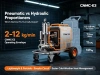
Walk into any spray foam supplier’s showroom and the conversation usually starts with hydraulic proportioners. They are the default for high-volume rigs, and for good reason: when you are laying down 14 kg/min or more across a full commercial roof, hydraulic drive gives you the sustained pressure and duty cycle to keep up.
But a large share of insulation and coating work does not look like that. Basement retrofits, cold storage panels, tank and pipe coating, small exterior wall runs—these jobs need 2 to 12 kg/min, not 24. They need a machine that one operator can move between floors, load into a pickup, and start spraying without a dedicated hydraulic technician on call. If your typical required output sits in this band, a pneumatic high-pressure proportioner may be a better fit than a bulky hydraulic rig.
That is the gap a pneumatic high-pressure polyurethane spray machine fills. The CNMC-E3 is a concrete example of how that configuration translates into field behavior, and it is worth walking through the specs that actually matter when you are matching a machine to this class of work.
What “Pneumatic High-Pressure” Actually Changes (Pneumatic vs. Hydraulic)
A pneumatic proportioner uses shop air—typically 0.5–0.8 MPa at ≥0.9 m³/min—to drive the chemical pumps, rather than a hydraulic power pack. The practical difference is not just “air vs oil.” It changes three things that show up every day:
- Weight and footprint. The CNMC-E3 sits at roughly 139 kg with dimensions around 750 × 540 × 1120 mm. That is light enough for two people to reposition without a forklift, and compact enough to fit through a standard doorway on a retrofit.
- Failure points. There is no hydraulic reservoir, no hydraulic pump, no hydraulic oil circuit to contaminate or overheat. The pneumatic circuit is simpler, and the components that do wear—seals, check valves, the air motor—are accessible and inexpensive relative to hydraulic drive components.
- Heat management. A hydraulic rig generates its own heat load from the power pack. A pneumatic unit’s heat comes primarily from the 7.5 kW primary heater and the heated hose. In cold-weather work, that separation makes it easier to bring A and B components up to spray temperature without fighting the machine’s own thermal mass.
The Specs That Decide Whether It Fits Your Job
Brochure output numbers are easy to quote and hard to use. Four specs determine whether a pneumatic machine like the CNMC-E3 matches your booked work:
| Spec | CNMC-E3 figure | What it means in practice |
|---|---|---|
| Chemical output | 2–12 kg/min | Covers residential retrofit, cold storage panels, and small commercial walls. Below 2 kg/min for touch-up is possible; above 12 kg/min sustained, a hydraulic unit is the better class. |
| Max working pressure | 11 MPa (~1,600 psi) | Within the high-pressure spray band. Adequate atomization for foam and polyurea coatings without pushing into the 25–35 MPa range reserved for heavy protective coatings. |
| Mix ratio | 1:1 by volume | Standard for spray foam. Ratio drift beyond roughly ±2% is the most common cause of off-ratio foam that never fully cures. Fixed-ratio pneumatic proportioners are mechanically simpler to hold on ratio than variable hydraulic systems when the machine is maintained. |
| Hose support | Up to 90 m | Enough reach for multi-floor retrofits and exterior wall work without moving the rig every hour. |
Where Pneumatic Stops and Hydraulic Starts
This is the part most suppliers skip. A pneumatic machine is not a “smaller hydraulic rig.” It is a different operating envelope.
Stay pneumatic when: your typical job runs under 12 kg/min sustained, you are moving between sites or floors multiple times a week, you do not want to carry hydraulic oil and a power pack into a finished interior, and your air supply is reliable (a tow-behind compressor in the 0.9 m³/min class is the baseline).
Move to hydraulic when: you are running full-day industrial roofing, the machine stays on one site for weeks, sustained output above 14 kg/min is the norm, and hose runs regularly exceed 120 m. A hydraulic unit like the CNMC-300 or CNMC-500L is the correct class for that envelope—not because pneumatic “cannot,” but because the duty cycle favors hydraulic drive.
One key limitation to note: pneumatic systems rely on stable, clean shop air. If your compressor cannot consistently deliver 0.5–0.8 MPa at ≥0.9 m³/min, pressure fluctuation will hurt atomization and mix consistency. For sites with poor air supply, hydraulic power remains the more reliable option.
Safety Is Not Optional in This Class
Spray polyurethane foam contains isocyanates. OSHA has identified these as the leading attributable chemical cause of work-related asthma, and NIOSH recommends supplied-air respiratory protection for indoor spraying, particularly in crawl spaces and confined areas. The machine’s built-in protections—multiple leakage protection circuits, emergency stop, and sub-36V control voltage—address electrical and operational risk. They do not replace respiratory protection, ventilation, and a written safety program. Any pneumatic or hydraulic spray machine in this class should be evaluated alongside those site controls, not instead of them.
What the CNMC-E3 Is, in One Paragraph
It is a 7.5 kW pneumatic high-pressure polyurethane/polyurea spray machine delivering 2–12 kg/min at 11 MPa, with a 1:1 fixed ratio, 7.5 kW heating, up to 90 m hose support, and a 139 kg frame that one or two people can reposition. It runs on 110V, 220V, or 380V depending on configuration. It is built for crews that need high-pressure atomization without a hydraulic power pack following them from job to job.
If You Are Still Comparing Configurations
Send us your typical daily output target (kg/min), the longest hose run on your booked jobs, and whether your air supply is single-phase or three-phase. We will tell you plainly whether the CNMC-E3 fits, or whether your volume points to a hydraulic unit—and if it points hydraulic, we will say so.
👉 Send your job parameters for a configuration check
Prefer to review the hard data first? Request the CNMC-E3 spec sheet PDF for full dimensional, heating, and electrical configuration details.
Related reading:
Polyurethane High-Pressure Spray Machine Daily Maintenance Guide: Extend Service Life by 3+ Years
CNMC-300 Hydraulic Polyurethane Spray Foam Machine: 15 kW, 2–24 kg/min
Related News










Contact US
Product Information
Quantity
Unit
Piece
Support order samples, customization, wholesale direct, and complete payment. If the product you look for does not have corresponding customized content, pls fill out the form below to contact us, and we will reply ASAP.